Getting AI to Recommend Your Brand: 3 AEO Strategies That Actually Work
Getting AI to Recommend Your Brand: 3 AEO Strategies That Actually Work
Getting AI to recommend your brand is a top, top priority for almost every marketing team right now. So if you are still not convinced that showing up in AI answers belongs alongside your SEO strategy, these numbers might just change your mind.
A study from Semrush shows that LLM visitors convert 4.4 times better than organic search visitors. And exactly like my client, conversions from answer engines are three to four times the rate of traditional organic search, and its already a top three revenue channel for them.
And that happens in months, not years. So if you want to win while its still early, this post breaks down three top strategies backed by Google's own documentation and real data.
Strategy 1: Build a Clear Brand Identity
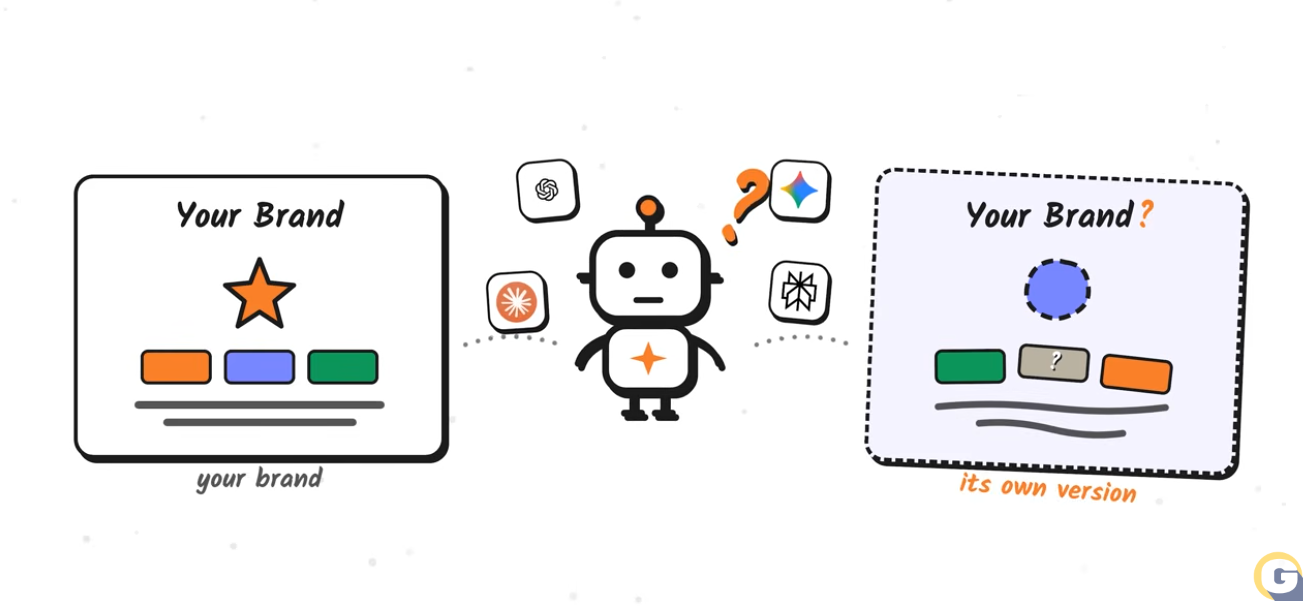
This one is simple but often overlooked. AI doesn't just take your word for what your brand is, its already building its own version of your brand identity. And when it isn't sure, it just ignores you.
Let me give you a real story. I have a client who is an e-commerce retailer selling home improvement products. After doing a brand audit, we found that AI actually recognized it as a manufacturer brand, not a retailer brand. That's a big problem, because AI won't even consider the brand when customers ask where to buy, since the brand description is just confusing.
Just like Google has tracked brands as entities for SEO for years, answer engines run on a similar logic. So the identity problem you might have been ignoring for SEO is now following you straight into AEO (Answer Engine Optimization).
Here's a quick exercise: ask AI directly what it knows about your brand and target customers. See how it understands your positioning, and check for any discrepancies. Do this for your competitors too.
To get clear on brand identity, you need three things:
- Who you are. Your category and what your brand actually does, in one or two sentences.
- Who you are for. Not everyone, be specific about the exact person your brand serves (in marketing, we call this the ICP, or ideal customer profile).
- What makes you different. The two or three things you want AI to always repeat about your brand.
If you can't answer these clearly yourself, AI will get confused too.
But there's one more important piece: these answers need to show up consistently, everywhere. Your website, your social profiles, your Google Business Profile, every directory that mentions your brand.
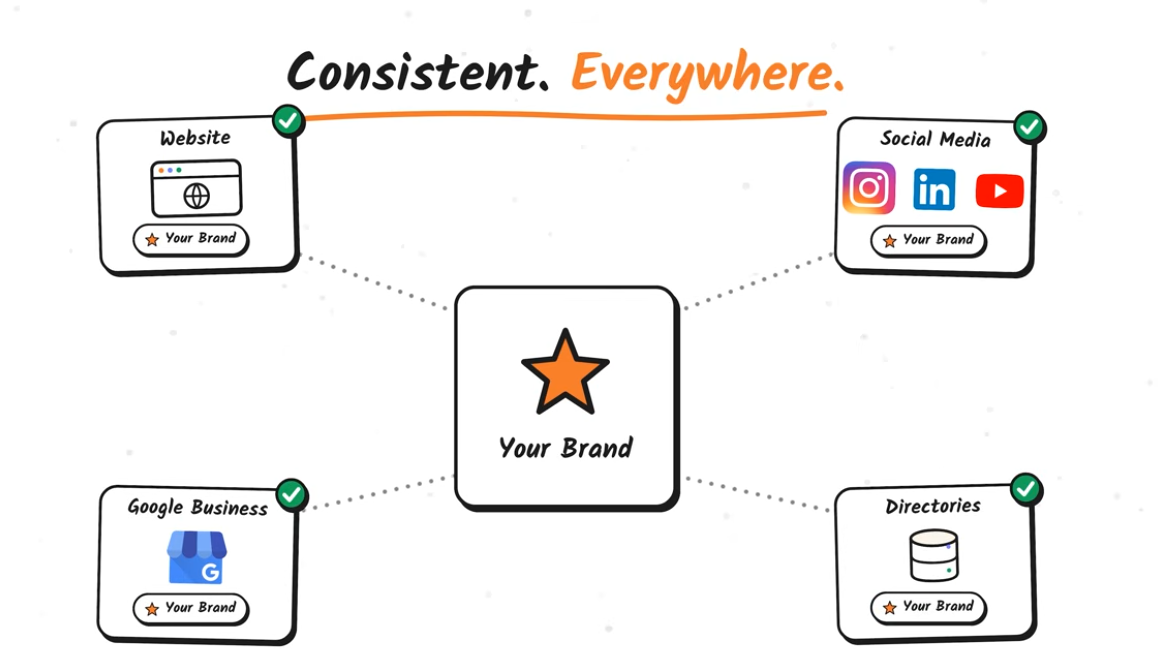
Think of it like a reference check. When someone is hiring you, they call a few of your references. If everyone describes you the same way, your chances of getting hired go up significantly. That's exactly what AI is doing with your brand, its tracking your entity footprint across the open web, and if the answers don't match, it lowers its confidence in you.
SparkToro actually ran a study tracking 3,000 prompts across ChatGPT, Claude, and Google AI. The chance of getting the same brand recommendation twice was less than 1 in 100, except for one brand that showed up with 97% visibility. Everyone else on the list constantly shuffled.
The randomness is real. AI doesn't work like Google, where you either rank or you don't. That's why in AEO, ranking isn't the metric that matters, the goal is to be considered consistently, every single time AI generates a response. And that starts with AI knowing exactly who you are.
Strategy 2: Own One Topic With Original Depth
For years, we've all been told to publish more content to feed the algorithm. But in AEO, study after study shows it doesn't reward the brand that publishes the most, it rewards the brand that covers one topic so deeply that it becomes the obvious answer.
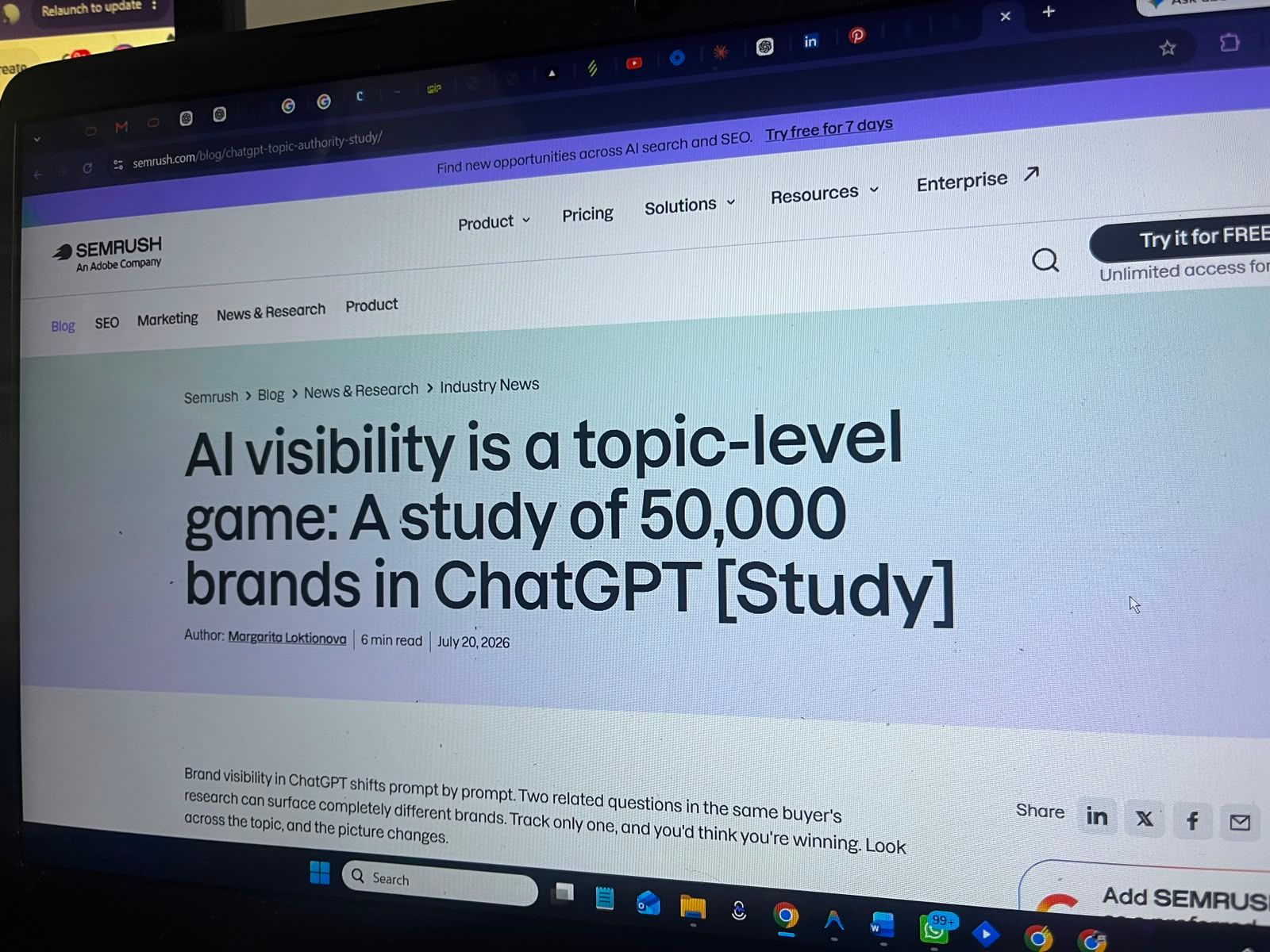
A research study from Semrush [The actual Study] and Kevin Indig tracked 50,000 brands across more than 1,000 topics in ChatGPT over six months. One finding was genuinely shocking: in nearly half the topics, the brand with better SEO didn't win, even when they had more traffic or a higher authority score.
So whatever decides who owns a topic in AI answers, it isn't broad domain strength alone. The leading theory is deep coverage plus entity presence on that specific topic.
Google's information gain patent backs this up too. It talks about prioritizing sources that add new information relative to what the user has already seen, using what it calls an "information gain score." That doesn't mean every LLM uses Google's exact scoring system, but LLMs are clearly looking for cite-worthy content that adds something new: original data, firsthand experience, and unique insight.
If your page just repeats what the top results already say, its score is basically zero. Doesn't matter how well written it is.
That's also why everyone rushing to automate content with AI won't get far without a clear focus and genuinely original depth. Because at the end of the day, the ultimate ranking factor is still human.
In a US antitrust trial, Google confirmed that ranking uses real user click behavior, Google tracks how real people interact with your content. Content people engage with gets treated as quality. Content they bounce off doesn't.
Does AEO work the same way? Nobody's confirmed it outright, but look at what these AI companies are building. OpenAI shipped a browser, Perplexity shipped a browser. User behavior data is clearly too valuable for them to ignore when evaluating whether content deserves to be recommended.
So how do you consistently get recommended by AI? You need to own what I'd call a "link", a specific set of prompts your buyers use on their journey from research to decision. It's about showing up across all those related questions, not just one random prompt.
That comes back to knowing your customer across every stage of the buying journey: what they ask when they first hit the problem, what they ask when comparing options, what they ask right before they choose. Most brands never map this out, or even track it using their own data.
If you don't have the internal data to start, use AI itself to generate these buyer question prompts, then review and refine them so they're specific to your business.
One useful signal here: check where your content is currently getting cited. In a lot of cases, listicle and "best of" style content tends to perform well for citations. It's a solid short-term tactic, but I wouldn't lean on it long-term. Whatever you create to win these citations, make sure it includes information the existing citations don't have, so your content becomes the more preferred answer.
Strategy 3: Engineer Third-Party Mentions
Now here's the thing. Your own content gets you cited and builds authority in a topic you want to own, but it still can't get you trusted.
Most of us spend hours on a beautiful website, better content, better design. You've actually done the work, and AI is still recommending other brands over and over. That's because your content gives AI something worth citing, but third-party positive mentions are what turn those citations into a name AI actually recommends.
The State of AI Search study from AirOps found that 80 to 90% of what AI engines reference comes from third-party sources, content the brand doesn't own. Someone else's article, someone else's video, someone else's social post, someone else's review.
Don't just take my word for it either, Google actually spells this out in its own Search Quality Rater Guidelines. They call it "reputation of the website and content creators." Google literally instructs raters to be skeptical of claims a website makes about itself, and instead look for independent reviews, references, and recommendations from experts.
And with the internet increasingly flooded with AI-generated content, that bar is only going to get higher. Google even gives raters exact search queries to use when checking a website's reputation. These rules aren't just for traditional search either, they apply to Google AI Overviews and very likely Google AI Mode too.
So the practical playbook here looks like:
- Track your citation channels. Figure out whether your mentions are coming from peer content, earned media, or user generated content, and go double down wherever's already working.
- Create net new content around topics where you already have some authority, this tends to be an easier win.
- Amplify socially. Post about topics you already own a "link" in.
- Watch high-intent community threads (Reddit is a big one, since its a common knowledge source for answer engines). Just don't pitch your brand directly there, that risks getting you banned. Add genuinely helpful value instead.
- Do outreach to the platforms already being cited for your specific prompts, you're literally targeting where AI is already pulling its answers from.
None of these are things to blindly execute either, always use your own judgement on whether a recommendation actually makes sense for your brand.
Strategy 4: The Reddit Secret Nobody Wants to Say Out Loud

Okay so here's the part of AEO nobody really wants to admit to. If you scroll through any discussion about AI search right now, one name keeps coming up again and again, and its Reddit.
And I don't mean Reddit as "just another platform to post on." I mean Reddit as the actual backbone a lot of these models are quietly leaning on.
Someone in a recent discussion put it in a pretty blunt way, he said a researcher from MIT basically told Paul Krugman that AI is mostly just summarizing what 36 year old males on Reddit think. So when someone says "ChatGPT told me the best car for me," what's actually happening is ChatGPT is summarizing what a bunch of dudes on a Reddit thread already said. That's it. That's the whole magic trick.
And here's the thing, once people realized this, some of them just stopped posting. One commenter said he used to answer tech questions on Reddit, then he noticed AI was scraping his answers and repeating them back the very next day. So he deleted his account. Which is kind of ironic right, the source dries up because the thing feeding off it got too greedy, too fast.
There was also this wild example someone shared about a phrase called "ascetic computing." The guy wrote it on his own personal website, just once, a month ago. No other source anywhere online used that phrase before him. And now if you search it on Google, Gemini gives you a confident summary of "what it means." Same thing happens on Bing with Copilot. Both of them just quietly turned one guy's blog post into established fact, no second source, no verification, nothing. That should worry you a little.
So why does this matter for your brand? Because if Reddit threads (and forums like it) are quietly becoming one of the main ingredients AI answers are built from, then showing up there, being mentioned there, being talked about there in a normal, non-spammy way, is not optional anymore. It is becoming one of the more powerful and least talked about levers in AEO.
But, and this is the dark part, it also means the incentive to manipulate it is massive. People are already talking openly about "AEO comments," basically content engineered specifically to get vacumed up by AI crawlers and fed back out as if it were organic consensus. One person flat out said the whole point of feeding garbage into these systems is to make it imposible to tell what's real from what's fake anymore, to poison the well for every topic, not just marketing ones.
And a librarian in the same thread just said "sighs deeply in librarian," which honestly says more than a whole paragraph could.
So what do you actually do with this. You don't fake it, don't go plant 50 sock puppet accounts hyping your brand, that stuff gets sniffed out and it also just isn't a good look if anyone ever traces it back. What you can do is show up genuinely. Answer real questions well. Be the account people actually trust in a thread, not the one that feels like an ad wearing a hoodie. Because if AI is already treating these spaces as a source of truth, being a real, useful presence there is quietly becoming one of the highest leverage things you can do for AEO right now, before everyone else catches on and floods it with noise.
Where to Start This Week
If you're wondering what order to tackle all this in, here's what I'd do:
First, run a brand audit. Ask ChatGPT, Gemini, and Perplexity one simple question: what does this brand do, and who is it for? If the answer is vague, wrong, or different across platforms, that's your first fix. Standardize how your brand is described everywhere AI looks, word for word.
Second, map your buyer's questions. Pick one lane you can go deeper on than anyone else. Every piece of content you publish should include something that doesn't exist anywhere else, your own data, your own results, your own take. This is also how you start earning brand trust.
Third, start building mentions you don't own. Reputation is what AI engines emphasize, they trust what others say about your brand far more than what you say about yourself. Find where AI is already pulling its answers from in your category, review sites, listicles, social posts, Reddit threads, and contribute value there. Pitch the roundups. Give people something worth referencing.
We Can Help With This
AEO is still new territory for most marketing teams, and figuring out brand identity, topic ownership, and third-party mentions all at once can get overwhelming fast. At Salhurry, we help brands audit their AI visibility, tighten up their brand identity across the web, and build the kind of content and outreach strategy that actually earns AI recommendations. If you're serious about showing up when your customers ask AI where to buy, we'd love to help you get there. Sorry for promoting ourselves at the last minute, hope you gained something useful from here.

Kiran
Project Manager